Package-page markdown (READMEs, descriptions, release notes) was
rendered as a plain document, so relative links and images resolved
against the site root and 404'd. This renders it in the context of the
package's linked repository instead, falling back to plain rendering
when the package has no linked repo.
For a README link `[usage](docs/usage.md)` in a package linked to
`user/repo` (default branch `main`):
| | Resolved link |
|---|---|
| Before | `/docs/usage.md` |
| After | `/user/repo/src/branch/main/docs/usage.md` |
For an npm monorepo package with `repository.directory: packages/foo`,
an image `` resolves to
`/user/repo/src/branch/main/packages/foo/logo.png`.
Applied to every package content template that renders markdown:
`cargo`, `chef`, `composer`, `npm`, `nuget`, `pub`, `pypi`. Links
resolve against the repository default branch (metadata records no
publish commit). Only the web package detail page is affected; registry
API responses are unchanged.
Note: as part of restructuring `npm.tmpl`, the package description and
README now render as separate sections instead of the README replacing
the description, matching the existing `cargo`/`composer`/`pub` layout.
Signed-off-by: wxiaoguang <wxiaoguang@gmail.com>
Signed-off-by: silverwind <me@silverwind.io>
Co-authored-by: silverwind <me@silverwind.io>
Co-authored-by: Claude (Opus 4.7) <noreply@anthropic.com>
Co-authored-by: wxiaoguang <wxiaoguang@gmail.com>
1. `origin-url` was introduced in the past when there was no good
framework support to detect current host url
    * It is not needed anymore
    * Removing it makes the code clearer
2. Separate template helper functions for different templates (web
page/mail)
3. The "AppURL" info is removed from admin config page: it doesn't
really help.
    * We already have various app url checks at many places
The code was just copied&pasted, it causes problems now.

There are a lot (for every package) broken translations. eg:

```
# en-US
conda.documentation = For more information on the Conda registry, see
<a target="_blank" rel="noopener noreferrer" href="%s">the documentation</a>.

# fr-FR (and many languages)
conda.documentation=Pour plus d'informations sur le registre Conda, voir
<a target="_blank" rel="noopener noreferrer" href="https://docs.gitea.io/fr-fr/packages/conda/">la documentation</a>.
```


To resolve the problem fundamentally, use a general string, and trigger
the re-translating on Crowdin side.


And, it should really really really avoid introducing too much
copied&pasted code .......
This PR follows:
* #21986
* #22831
This PR also introduce customized HTML elements, which would also help
problems like:
* #17760
* #21429
* #21440
With customized HTML elements, there won't be any load-search-replace
operations, and it can avoid page flicking (which @silverwind cares a
lot).
Browser support:
https://developer.mozilla.org/en-US/docs/Web/API/Window/customElements
# FAQ
## Why the component has the prefix?
As usual, I would strongly suggest to add prefixes for our own/private
names. The dedicated prefix will avoid conflicts in the future, and it
makes it easier to introduce various 3rd components, like GitHub's
`relative-time` component. If there is no prefix, it's impossible to
introduce another public component with the same name in the future.
## Why the `custcomp.js` is loaded before HTML body? The `index.js` is
after HTML body.
Customized components must be registered before the content loading.
Otherwise there would be still some flicking.
`custcomp.js` should have its own dependencies and should be very light,
so it won't affect the page loading time too much.
## Why use `data-url` attribute but not use the `textContent`?
According to the standard, the `connectedCallback` occurs on the
tag-opening moment. The element's children are not ready yet.
## Why not use `{{.GuessCurrentOrigin $.ctx ...}}` to let backend decide
the absolute URL?
It's difficult for backend to guess the correct protocol(scheme)
correctly with zero configuration. Generating the absolute URL from
frontend can guarantee that the URL is 100% correct -- since the user is
visiting it.
# Screenshot
<details>
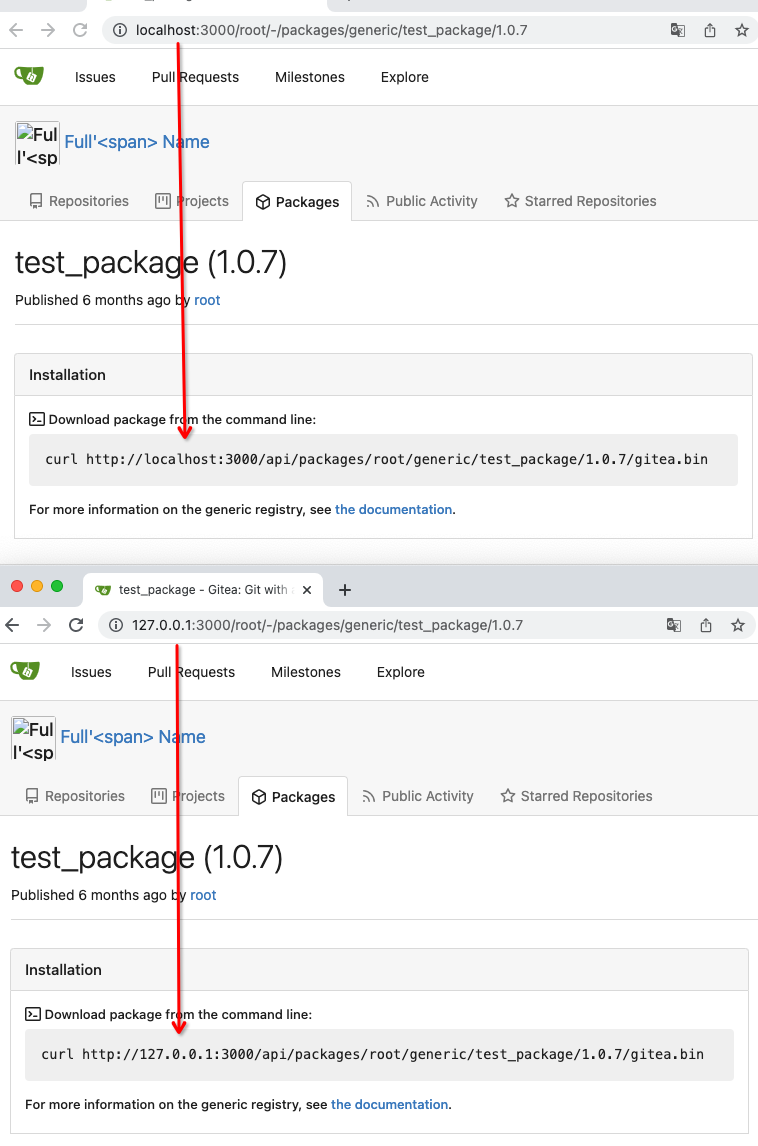
</details>
 Thomas Hallock
 wxiaoguang
 silverwind
 delvh
delvh
 Lunny Xiao
 KN4CK3R
 Zettat123
